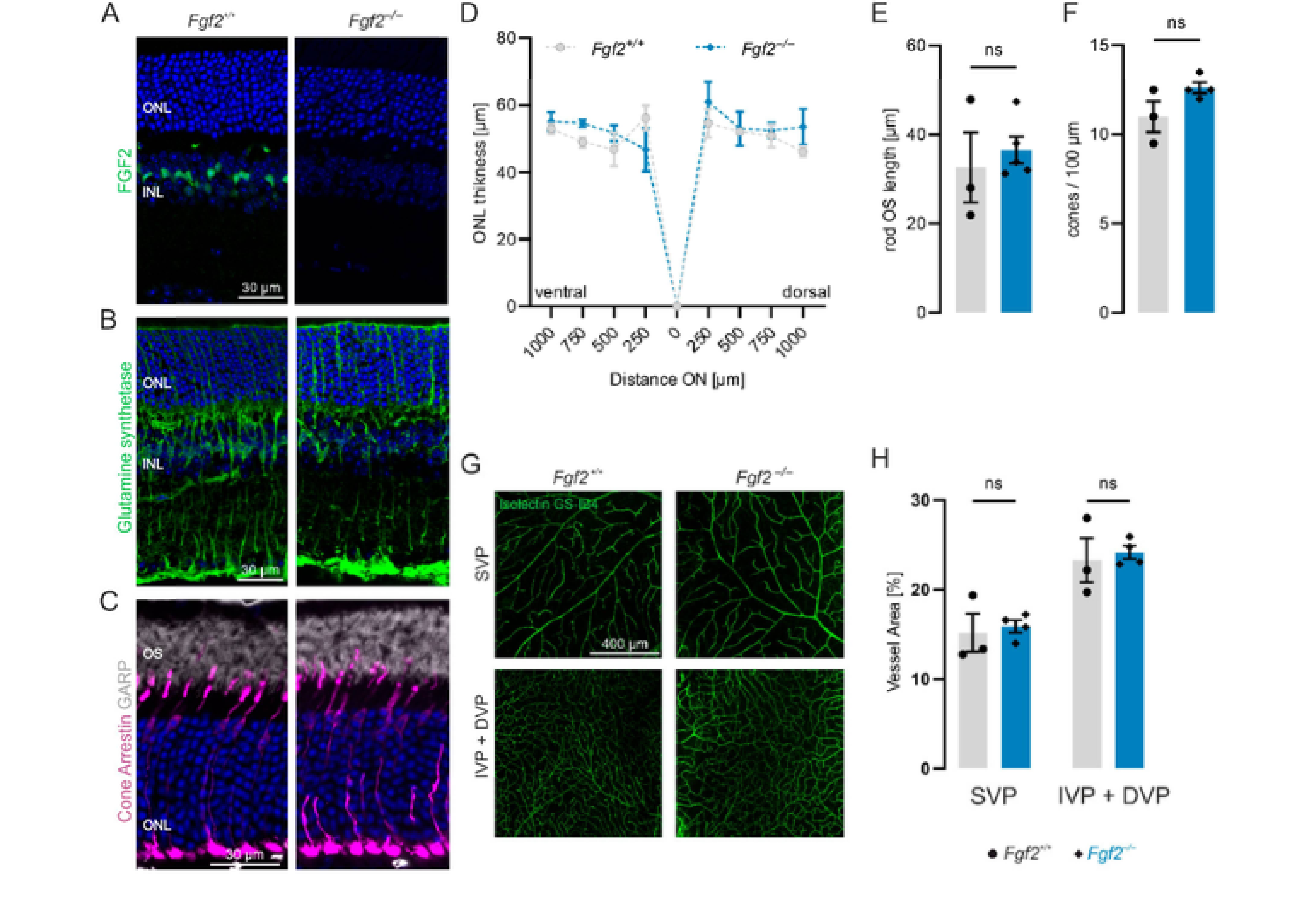
Fibroblast growth factor 2 (FGF2) is expressed in retinal Müller glia cells, and its expression increases in response to photoreceptor degeneration. To investigate the physiological relevance of FGF2, we analyzed retinal morphology and cellular responses in Fgf2-deficient (Fgf2-/-) mice. Loss of FGF2 did not affect photoreceptor survival, retinal vasculature, or retinal pigment epithelium (RPE) integrity. To further understand its role in retinal degeneration, Fgf2-/- mice were crossed with Pde6bSTOP/STOP mice, a model of retinitis pigmentosa (RP). We then analyzed outer nuclear layer thickness, cone number, rod outer segments length, RPE morphology, and microglia number in Fgf2-/-Pde6bSTOP/STOP and Pde6bSTOP/STOP mice. Although FGF2 was upregulated in degenerating photoreceptor cells in the Pde6bSTOP/STOP retina, its absence did not accelerate photoreceptor loss in Fgf2-/-Pde6bSTOP/STOP mice. Interestingly, microglia numbers were significantly changed at early disease stages in Fgf2-/-Pde6bSTOP/STOP retinas compared with Pde6bSTOP/STOP controls, suggesting that FGF2 modulates inflammatory signaling. Together, these results show that loss of FGF2 does not alter photoreceptor degeneration kinetics or retinal morphology, but may contribute to the regulation of early microglial accumulation during degeneration.